What Is EMSA Preventive Health and Safety Training?
EMSA Preventive Health and Safety training is an educational program for childcare providers covering health practices that support children’s safety and well-being. The California Childcare Health Program at the University of California, San Francisco, describes the eight-hour curriculum through three primary modules: prevention of infectious disease, prevention of injuries, and nutrition.
These subjects apply to everyday childcare responsibilities. Providers must maintain clean environments, recognize potential hazards, respond appropriately to children’s health needs, and establish routines that reduce avoidable risks.
For Bay Area childcare professionals, understanding these principles can support consistent practices across home-based childcare settings and larger early learning centers. The course also helps learners understand how preventive health education fits into California’s childcare licensing framework.
California Childcare Licensing: What Providers Should Know
California’s childcare licensing system is administered through the California Department of Social Services and its Community Care Licensing Division. Applicable training requirements can vary depending on the facility, the provider’s responsibilities, and current regulations.
Preventive Health and Safety education is distinct from pediatric CPR and First Aid training. Childcare professionals should determine which courses and completion documents are required for their specific situation rather than assuming that one course covers every licensing obligation.
The California Department of Social Services’ childcare training resources explain the broader training framework and provide information for childcare providers.
For people opening a Family Child Care Home, applying to work at a Child Care Center, or reviewing existing training records, checking the current requirements before enrolling can help avoid unnecessary delays.
Core Health and Safety Topics for Childcare Professionals
The Preventive Health and Safety curriculum connects classroom learning with situations childcare professionals encounter regularly.
- Infectious disease prevention: Handwashing, appropriate hygiene, cleaning, and sanitation help reduce opportunities for germs to spread between children and caregivers.
- Injury prevention: Recognizing unsafe play areas, age-inappropriate equipment, and common environmental hazards helps providers make childcare spaces safer.
- Environmental sanitation: Clean food preparation areas, properly maintained toilets, and sanitary diaper-changing routines support healthier daily operations.
- Child health observation: Understanding common health concerns helps providers identify changes in a child’s condition and communicate concerns appropriately.
- Safe daily routines: Consistent procedures for cleaning, supervision, and responding to illness help childcare teams follow established health policies.
The curriculum’s three-module structure provides a framework for understanding how infection control, injury prevention, and nutrition contribute to children’s well-being.
Lead Poisoning Prevention in Bay Area Childcare Settings
Lead exposure is a serious health concern for young children because it can affect development and learning. Potential sources include deteriorating lead-based paint, contaminated dust, and soil containing lead. Exposure may occur without obvious symptoms.
Childcare providers should understand how to maintain clean environments, prevent children from accessing potentially hazardous materials, and communicate environmental concerns to facility managers and families. In older buildings, it is particularly important to address suspected hazards through appropriate assessment rather than assuming that a surface or structure is safe.
Across the Bay Area, childcare providers work in a variety of residential and commercial buildings. The age and condition of an individual property can affect which environmental precautions deserve attention, but a building’s location alone does not establish that lead is present.
Lead poisoning prevention is included in the current EMSA-approved Preventive Health curriculum. Providers can consult the California Childcare Health Program’s training resources for further information.
Nutrition, Food Allergies, and Children’s Well-Being
Nutrition education helps childcare professionals understand the relationship between daily meals, children’s development, and safe food practices.
Age-appropriate meals and snacks help accommodate children’s changing nutritional needs. Providers may also need to follow family-provided instructions concerning food allergies, specialized diets, and medical conditions such as diabetes. Clear communication and consistent food-handling practices can help reduce avoidable risks.
Feeding difficulties and concerns about growth should be communicated to parents or guardians, with appropriate medical guidance sought when needed. Childcare professionals are responsible for following established care procedures, not diagnosing medical conditions.
Dental health also belongs in the broader discussion of childhood nutrition. Appropriate food choices and consistent hygiene routines can help support children’s oral health.
The nutrition module in the EMSA Preventive Health and Safety curriculum provides relevant education for providers who plan meals, supervise snacks, and support children’s daily care.
Who Should Consider EMSA Childcare Training Across the Bay Area?
The course may be relevant to several groups throughout the region:
- Family Child Care Home providers: People operating home-based childcare programs may need to understand sanitation, safe food practices, infection prevention, and environmental hazards.
- Child Care Center staff: Teachers, directors, and other relevant personnel may benefit from education that supports consistent health and safety procedures.
- Prospective childcare workers: Individuals preparing for childcare employment can explore the course while checking which training their intended role requires.
- Childcare business applicants: People preparing to open a licensed childcare operation can review applicable training requirements early in the planning process.
- Existing childcare professionals: Current providers may need to complete required coursework or verify that their documentation meets applicable regulations.
The correct training pathway depends on each learner’s circumstances. Completing an EMSA course does not automatically satisfy every licensing or employment requirement.
Childcare Training Near San Francisco, Oakland, and Other Bay Area Communities
The Bay Area spans multiple counties and includes communities with different childcare and transportation needs. Safety Training Seminars’ San Francisco location may be an option for providers working in the city or considering training while traveling from nearby communities.
Relevant areas include:
- San Francisco: Childcare providers working in neighborhoods such as SoMa, Mission Bay, and Potrero Hill.
- Daly City and South San Francisco: Communities immediately south of San Francisco.
- Oakland and Berkeley: East Bay cities with their own childcare and early education communities.
- San Mateo and Redwood City: Peninsula communities where providers may seek training options closer to their work or home.
- San Jose: A major South Bay city with childcare professionals who may compare training options throughout the region.
These communities are not all within the same county, and travel convenience varies by starting point. Learners should consider their individual location and verify the course format before registering.
Safety Training Seminars in San Francisco, CA
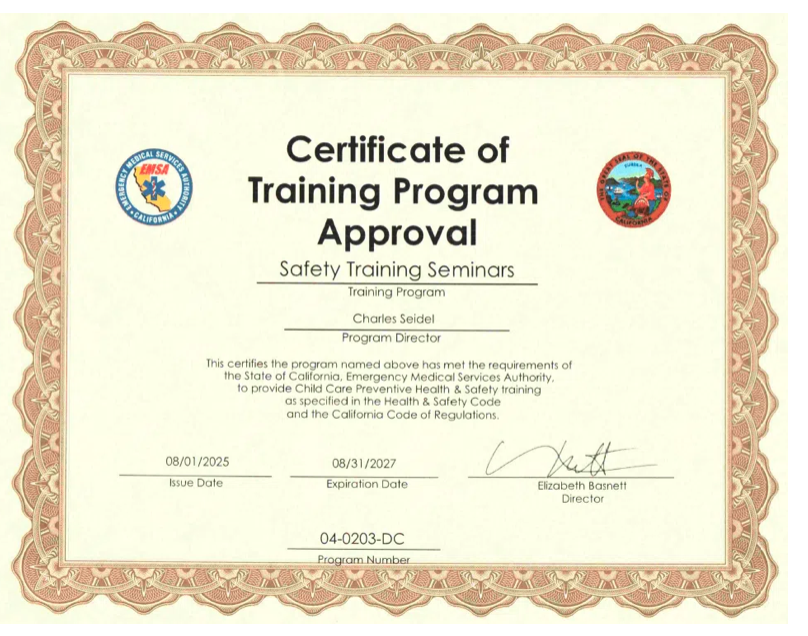
Safety Training Seminars lists an EMSA Health and Safety course on its San Francisco training page and provides a local training center in the city’s South of Market area.
Training center address:Safety Training Seminars 350 Townsend St, Suite 426 San Francisco, CA 94107
The location provides a starting point for Bay Area childcare professionals exploring available training options. Before registering, review the course listing to confirm the current delivery format, available dates, fees, and completion documentation.
How to Choose the Appropriate Course
Before enrolling, Bay Area childcare professionals should take a few practical steps:
- Confirm the requirement. Determine whether your role calls for Preventive Health and Safety training, pediatric CPR and First Aid, or multiple courses.
- Check the course curriculum. Verify that the selected program covers the subjects required for your situation.
- Review registration details. Confirm the format, schedule, fees, and enrollment instructions with the provider.
- Verify completion documentation. Ask what documentation is issued after successfully completing the course.
- Consult the licensing authority. If you are unsure which requirements apply, review current guidance from Community Care Licensing or contact the appropriate authority.
The state’s EMSA training program directory can also help learners locate training programs and contact providers about available courses.
Find EMSA Childcare Health and Safety Training Across the Bay Area
Safety Training Seminars provides a San Francisco option for childcare professionals exploring EMSA Preventive Health and Safety education. From infection prevention and injury reduction to nutrition and lead poisoning prevention, the course addresses health practices that matter in everyday childcare environments.
If you work in San Francisco, the East Bay, the Peninsula, or the South Bay, start by identifying your specific training requirements and reviewing the available course details. Choose the appropriate program, verify the completion documentation, and consult California’s licensing guidance whenever requirements are unclear.