Walking into your first CPR or BLS class is usually more practical than people expect.
For SF Bay Area, CA students, the experience depends on the course you choose. A BLS CPR Certification Course is generally intended for healthcare professionals and others who need clinical-level basic life support skills, while CPR/First Aid may be more appropriate for workplace staff, teachers, parents, caregivers, and the public. The American Heart Association advises learners to confirm the exact course required by their employer before enrolling.
Key Takeaway: Expect your first class to be active. You may practice chest compressions, breaths or ventilations, AED use, choking response, and other course-specific skills, then complete the required knowledge or skills evaluation for your training pathway.
Before Class: Make Sure You Registered for the Right Course
Many first-time students use “CPR class” and “BLS class” as if they mean the same thing, but the credentials serve different audiences.
The American Heart Association describes BLS as training for healthcare professionals and other personnel who need CPR and basic cardiovascular life-support skills in in-hospital or out-of-hospital settings. Current BLS content includes recognition of life-threatening emergencies, high-quality chest compressions, appropriate breaths and ventilations, and early AED use.
If you are a nurse, nursing student, EMT, dental professional, medical assistant, or another healthcare worker, your employer or school may specifically request BLS. If you need general CPR, AED, or First Aid training for a workplace or community role, another course may fit better.
SF Bay Area students who know they need healthcare-provider training can review the BLS certification course options for the SF Bay Area before choosing a class. Safety Training Seminars currently lists BLS training specifically for healthcare professionals who may respond to cardiac and respiratory emergencies.
What Happens When Your First CPR or BLS Class Begins?
Your class should begin by establishing the response sequence and skills you will be expected to perform. The instructor or training system may introduce how to recognize an emergency, activate the emergency response system, begin CPR, and use an AED.
The AHA currently supports full classroom BLS as well as blended learning, where online coursework is followed by a hands-on skills session. Safety Training Seminars also lists instructor-led and self-guided learning options for Bay Area learners.
If you use a blended or self-guided format, complete any assigned online portion before arriving. Review your registration details so you know whether your appointment is a full course, an online-plus-skills pathway, or a skills session. Students interested in flexible training can review the self-guided BLS CPR learning option.
Expect to Spend Time Practicing CPR Skills
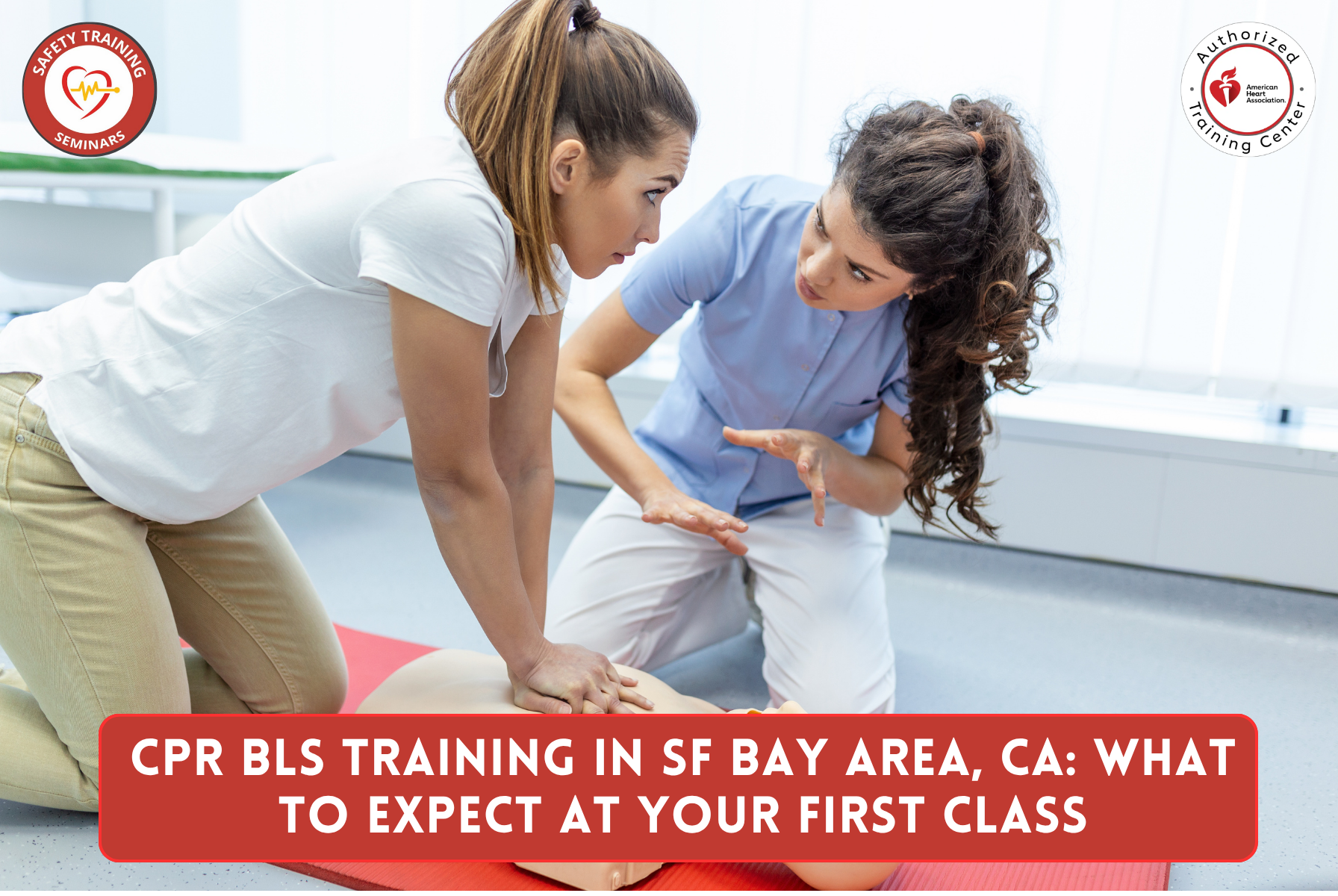
Hands-on practice is a major part of a first BLS or CPR class. Reading about chest compressions is different from practicing hand placement, compression technique, recoil, and the rhythm of a complete CPR sequence.
BLS training covers high-quality CPR and includes skills applicable to adult, child, and infant emergencies, along with appropriate breaths and ventilation.
Do not worry if the first attempt feels awkward. New students often need repetition to coordinate compressions, breaths, and transitions. Wear clothing that allows you to kneel, bend, and move comfortably because the skills portion of CPR training is physical.
The goal during a first class should not be to perform everything perfectly immediately. Pay attention to corrections and use practice time to build a repeatable technique.
You Will Learn How an AED Fits Into the Response
An automated external defibrillator, or AED, is used as part of the response to cardiac arrest. Current AHA BLS training specifically includes early AED use along with high-quality chest compressions and appropriate ventilation.
In class, you learn where the device fits into the CPR sequence and how rescuers coordinate compressions, AED operation, and other response tasks.
First-time students should focus on following the sequence taught during training rather than treating CPR and AED use as separate skills.
For students who need community CPR rather than healthcare-provider BLS, Safety Training Seminars provides information about CPR certification classes in the SF Bay Area.
BLS Also Emphasizes Team Response
One difference first-time BLS students may notice is the emphasis on coordinated care. The AHA describes BLS as teaching both single-rescuer and team basic life support, with a focus on high-quality CPR and team dynamics.
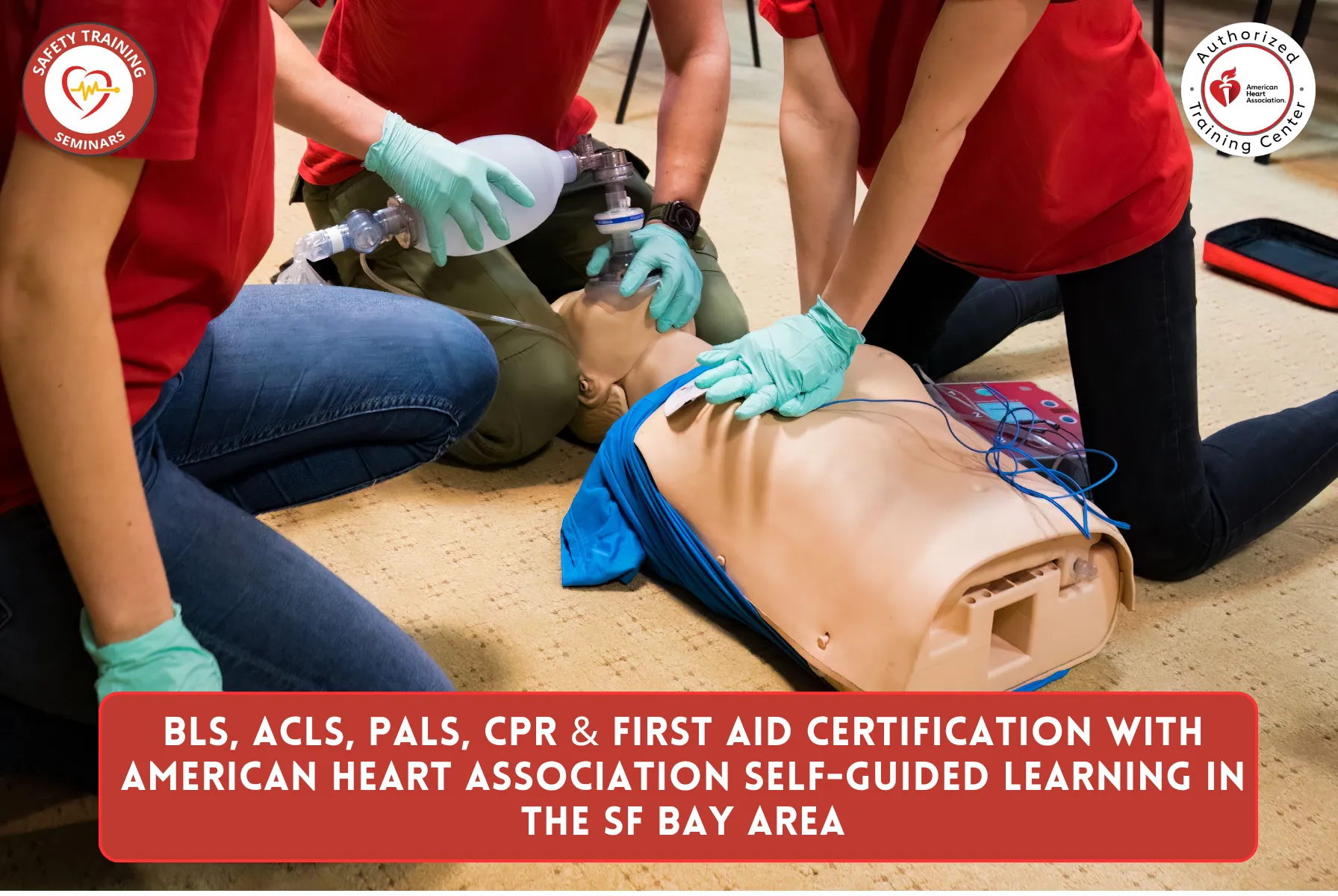
In a training scenario, one rescuer may perform compressions while another handles another part of the response, such as ventilation or AED preparation.
This is especially relevant for healthcare professionals who may respond with colleagues in hospitals, clinics, dental practices, and other medical environments. The class helps students understand not only individual CPR skills but also how those skills fit into an organized team response.
How Skills Checks and Course Completion Work
Do not assume that attendance alone completes every requirement. CPR and BLS programs may involve knowledge assessment, skills evaluation, or both depending on the course and delivery format.
For blended BLS, the AHA describes the pathway as HeartCode BLS followed by a hands-on skills session. Before class, check your registration confirmation for prerequisites or online work. During training, listen to feedback and correct your technique when prompted.
If your employer, school, or licensing organization has a specific documentation requirement, confirm it before enrolling rather than discovering afterward that you completed a different course.
What Should You Bring to Your First Class?
Preparation is usually simple:
- Bring your registration confirmation or class instructions.
- Complete required online coursework beforehand if you enrolled in a blended pathway.
- Wear comfortable clothing suitable for kneeling and hands-on practice.
- Bring identification or documentation requested in your registration instructions.
- If renewing, check whether your course asks for information from your current certification.
- Follow the location and check-in instructions provided by the training center.
You do not need to memorize every CPR step before your first class. Training is where you learn the process, practice the skills, receive feedback, and demonstrate what the course requires.
Your SF Bay Area Training Location
Safety Training Seminars lists a San Francisco Mission Bay training location at 350 Townsend St, Suite 426, San Francisco, CA 94107. The current San Francisco location directory identifies the Townsend Street site as the Mission Bay location and lists BLS and other resuscitation-course options.
The Townsend Street location may be relevant for students and professionals coming from Mission Bay, SoMa, South Beach, Downtown San Francisco, and surrounding parts of the city. Safety Training Seminars’ current information identifies these areas in relation to the Mission Bay center.
Before traveling, verify the location listed on your specific registration because Safety Training Seminars currently lists multiple San Francisco training centers.
If you are comparing CPR with First Aid requirements, review the SF Bay Area CPR and First Aid certification course and match the course to your employer or program’s wording.
FAQs About a First CPR BLS Class in the SF Bay Area
Is a first BLS class difficult if I have never taken CPR before?
Being new to CPR does not mean you should arrive already knowing every technique. Expect instruction, demonstrations, hands-on practice, and evaluation. Concentrate on learning the sequence and responding to feedback. If BLS is required for your healthcare job or academic program, check your specific course information for any prerequisites before attending.
Will I have to perform CPR on a real person?
CPR training uses practice methods and equipment that allow students to develop and demonstrate the required techniques in a controlled training environment. Follow the instructions given during your specific class or skills session regarding manikins, AED trainers, ventilation equipment, and the skills you must demonstrate.
Can I take part of my BLS course online in the SF Bay Area?
Yes. The AHA offers blended BLS through HeartCode BLS followed by a hands-on skills session. Completing an online component alone should not be confused with completing the entire blended pathway when a hands-on session is still required.
How do I know whether I need BLS or regular CPR?
Check the exact wording from your employer, school, clinical program, or licensing organization. The AHA identifies BLS primarily for healthcare professionals and other personnel who need basic cardiovascular life-support skills, while other CPR and First Aid programs serve different audiences and workplace needs.
What if I need ACLS, PALS, or NRP instead?
Do not assume BLS, ACLS, PALS, NRP, and general CPR courses are interchangeable. They address different training needs, patient populations, or levels of response. Review the specific course information and confirm the credential requested by your employer, school, hospital, or professional organization before registering.
Prepare for Your First Class With the Right Expectations
Your first CPR or BLS class in the SF Bay Area should be approached as practical skills training, not simply a certification formality. Start by confirming whether you need BLS, CPR/First Aid, ACLS, PALS, NRP, or another credential. Then check the training format and finish any required online work before arriving.
During class, focus on practicing the response sequence, AED use, compressions, ventilation, and any required team skills.
Safety Training Seminars offers several SF Bay Area course options, including BLS CPR training at its San Francisco locations. Before enrolling, review the appropriate course page for current registration details, training format, and location information. Choosing the correct course before your first class helps you avoid completing training that does not match your professional, academic, or workplace requirement.