Navigating healthcare credential requirements across San Francisco and the broader Bay Area can quickly become confusing. Job postings at major medical centers, outpatient surgical clinics, and community health centers routinely list Basic Life Support (BLS), Advanced Cardiovascular Life Support (ACLS), or Pediatric Advanced Life Support (PALS) as mandatory prerequisites. Registering for the wrong resuscitation class delays onboarding, while taking an advanced course without foundational training can leave you unprepared for the required skills testing.
Choosing the correct certification depends on your specific clinical role, your scope of practice, and the age group of the patients you treat. This guide breaks down the clinical distinctions between BLS, ACLS, and PALS, maps each certification to specific healthcare jobs, and helps you identify the exact training required for your employment or academic program in the SF Bay Area.
Key Takeaway: BLS covers fundamental CPR, AED usage, and airway management for patients of all ages and is required for almost all healthcare roles. ACLS builds on BLS to focus on adult cardiac arrest algorithms and pharmacology, while PALS focuses on pediatric respiratory emergencies and advanced resuscitation.
Understanding the Scope of Resuscitation Certifications
Resuscitation courses are structured in a clear hierarchy. Advanced courses do not replace foundational training; instead, they build upon the core physical skills mastered during basic CPR instruction.
Basic Life Support (BLS)
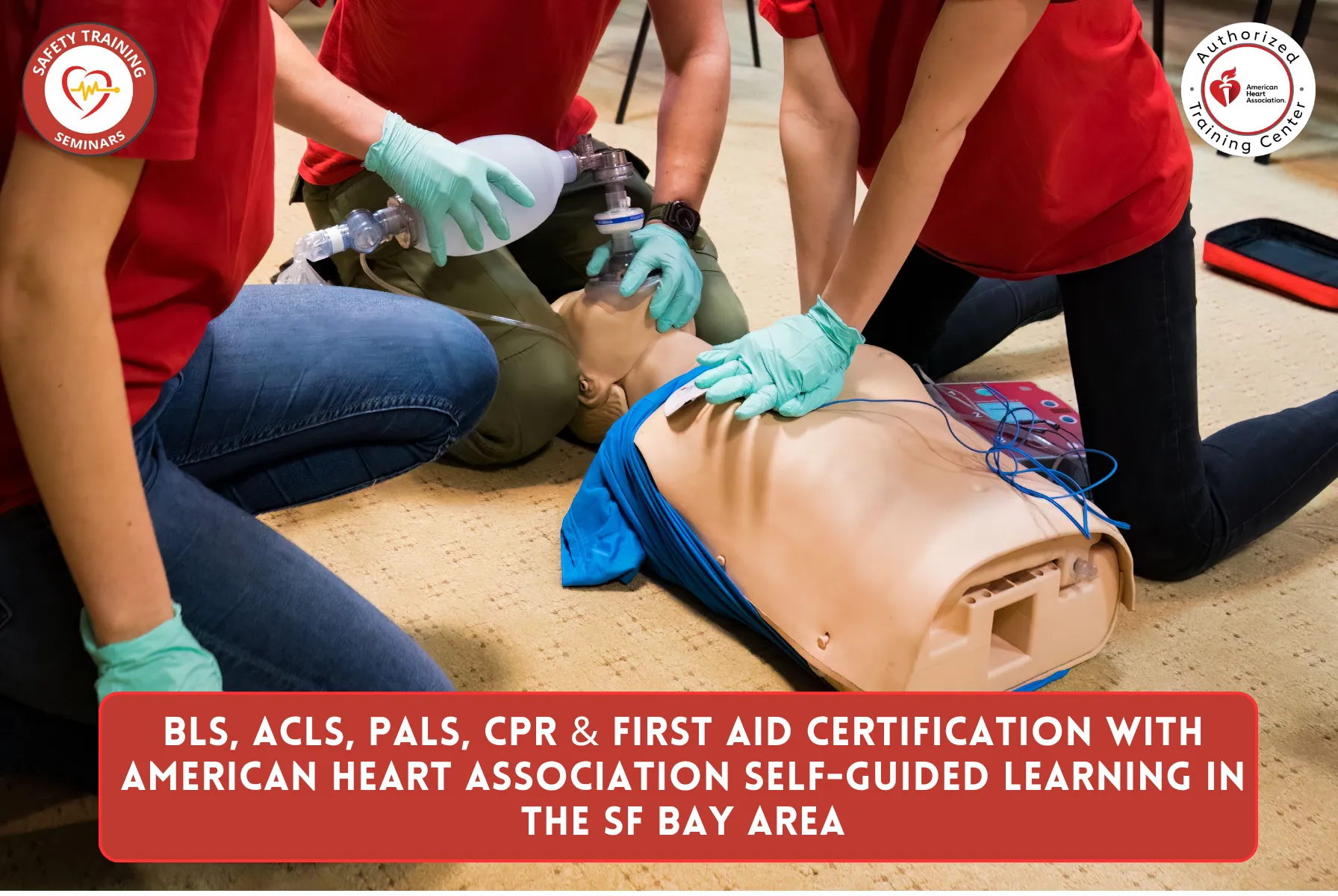
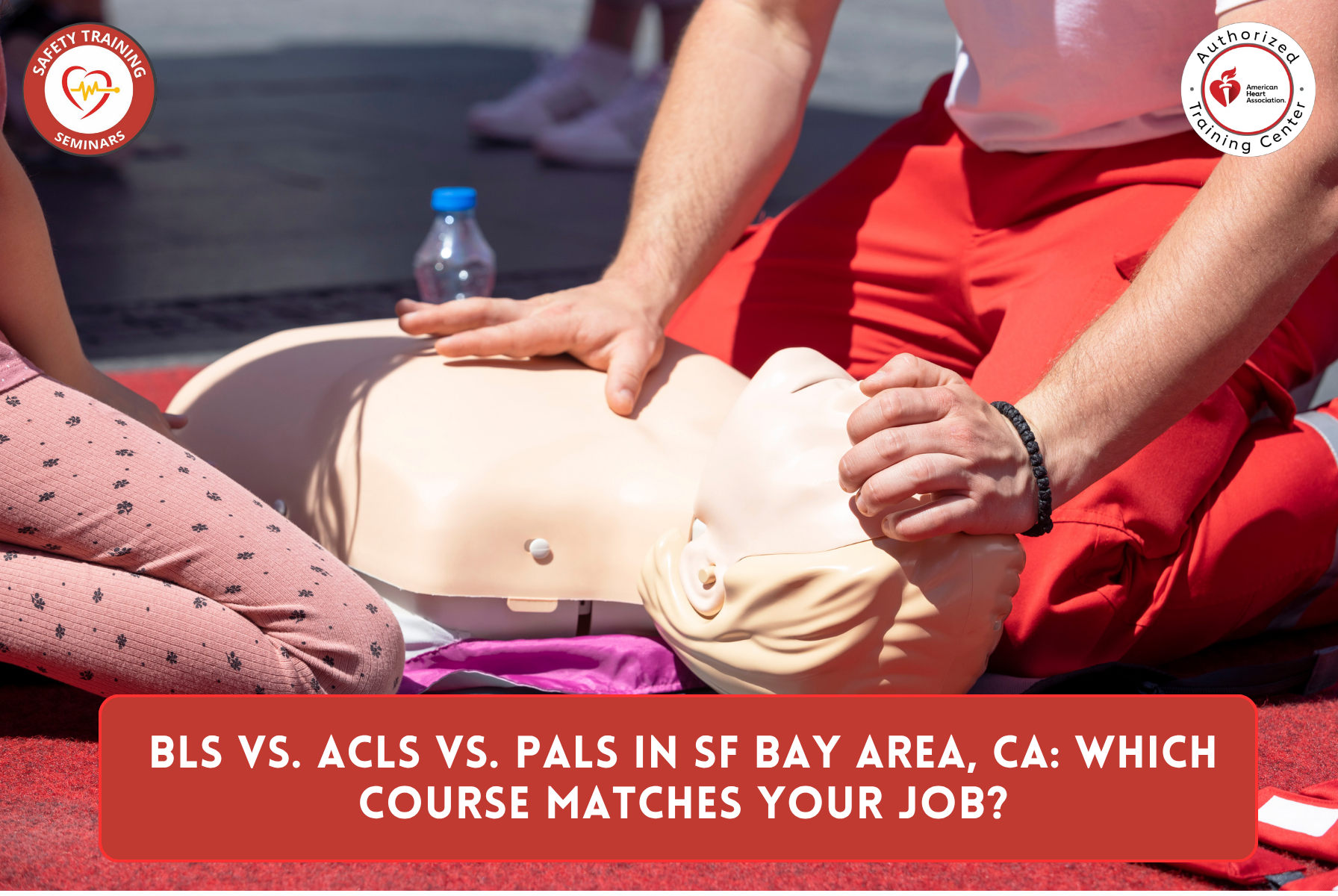
The BLS CPR Certification Course is the foundational standard for healthcare professionals. Developed primarily by the American Heart Association (AHA), BLS teaches single-rescuer and team-based resuscitation skills for adult, child, and infant patients. Key competencies include high-quality chest compressions, bag-mask ventilation, automated external defibrillator (AED) operation, and relief of foreign-body airway obstructions.
Advanced Cardiovascular Life Support (ACLS)
ACLS is designed for healthcare providers who manage or direct adult neurovascular and cardiovascular emergencies. The curriculum goes beyond basic physical CPR to emphasize ECG rhythm recognition, cardioversion, manual defibrillation, intravenous/intraosseous resuscitation pharmacology, and advanced airway management. A current BLS card is a mandatory prerequisite for enrolling in ACLS.
Pediatric Advanced Life Support (PALS)
PALS focuses on systemic assessment and intervention for infants and children facing critical illness or injury. Because pediatric cardiac arrest most frequently stems from severe respiratory failure or shock rather than primary cardiac conditions, PALS emphasizes early intervention, pediatric vascular access, weight-based drug dosing, and pediatric advanced airway management.
Which Certification Matches Your Specific Healthcare Role?
Employers establish certification requirements based on unit acuity, patient demographics, and state regulatory mandates. Reviewing common position standards helps ensure you register for the proper class.
General Clinical Roles & Students: BLS Required
Basic Life Support is universally required across inpatient and outpatient care settings. If you are entering a health professions program or working in general patient care, BLS is almost always your required baseline.
- Nursing and Medical Students: Required prior to starting hospital clinical rotations.
- Outpatient & Medical Clinic Staff: Medical assistants (MAs), phlebotomists, and certified nursing assistants (CNAs).
- Dental Professionals: Dentists, registered dental hygienists, and dental assistants.
- Allied Health Providers: Physical therapists, occupational therapists, radiologic technologists, and speech-language pathologists.
Adult Acute & Critical Care: ACLS Required
Facilities operating high-acuity adult units mandate ACLS to ensure clinicians can manage complex cardiac events and lead code teams.
- Critical Care Nurses: ICU, CCU, post-anesthesia care unit (PACU), and telemetry RNs.
- Emergency Department Personnel: ED nurses, attending physicians, and resident physicians.
- Advanced Practice Providers: Physician assistants (PAs) and nurse practitioners (NPs) in acute care.
- First Responders: Paramedics and critical care transport specialists.
Pediatric & Neonatal Specialties: PALS Required
Clinicians caring for pediatric populations must hold specialized pediatric credentials to handle age-specific resuscitation protocols.
- Pediatric Care Providers: PICU nurses, NICU staff, and pediatric emergency specialists.
- Outpatient Pediatrics: Pediatric clinic nurses, pediatric dental providers handling sedation, and school nurses in high-acuity settings.
- General Emergency Staff: Clinicians in mixed adult/pediatric EDs often need both ACLS and PALS alongside their BLS credential.
Comparing Course Content, Testing, and Prerequisites
Reviewing prerequisites and assessment methods helps you determine your readiness for advanced resuscitation training.
| Feature | Basic Life Support (BLS) | Advanced Cardiovascular Life Support (ACLS) | Pediatric Advanced Life Support (PALS) |
| Primary Focus | High-quality CPR, AED, & basic airways | Adult ECG rhythms, drugs, & code leadership | Pediatric systematic assessment & algorithms |
| Prerequisites | None | Current BLS card & ECG interpretation | Current BLS card & pediatric drug dosing |
| Target Population | Adult, child, and infant | Adult patients | Infants and children |
| Key Skills | Compressions, bag-mask, choking care | Manual defibrillation, IV/IO meds, intubation | Broselow tape use, IO access, airway management |
| Testing Method | Individual skills test & written exam | MegaCode team lead scenario & written exam | Pediatric case scenario & written exam |
Bay Area Clinical Requirements and Student Needs
San Francisco Bay Area healthcare institutions maintain rigorous standards for employee credentialing. Major regional healthcare systems—including UCSF Health, Sutter Health, Kaiser Permanente, and Zuckerberg San Francisco General Hospital—require staff to hold active American Heart Association provider cards.
Nursing and allied health students at local institutions such as San Francisco State University, the University of San Francisco, and City College of San Francisco must secure an active BLS card before setting foot in clinical settings. Securing training near your campus or residential neighborhood saves valuable commute time during busy academic blocks.
For professionals commuting across San Francisco neighborhoods, finding a local training site makes maintaining valid credentials straightforward. Healthcare workers residing in areas like Outer Sunset, CA, Sea Cliff, CA, and Lake Street, CA frequently look for flexible scheduling options that fit demanding shift rotations.
Life Support Training at Safety Training Seminars in San Francisco
Healthcare providers and students throughout the region rely on Safety Training Seminars for official American Heart Association certification. Courses follow a convenient blended learning model, combining self-paced online cognitive modules with a fast, hands-on skills verification session at a local training site.
Upon passing your in-person skills evaluation, your official AHA eCard is issued on the same day. This ensures you can submit proof of certification to your employer or nursing program without waiting for physical mail delivery.
The local San Francisco training center is situated at:
Safety Training Seminars: 350 Townsend St, Suite 426, San Francisco, CA 94107
This location offers convenient access for healthcare professionals traveling from across the city, including those commuting from Laurel Heights, Lone Mountain, or the Inner Sunset, CA area. Clinicians coming from the Central Sunset, CA district can easily coordinate their hands-on assessment around shift schedules.
Frequently Asked Questions
Do Bay Area healthcare employers accept 100% online CPR cards?
No. Hospitals, surgery centers, and clinical academic programs throughout San Francisco and the Bay Area do not accept certificates from courses completed entirely online without a physical skills demonstration. Employers require hands-on skills verification using physical resuscitation manikins under accredited AHA guidelines.
Can I take BLS and ACLS on the same day?
Yes. Through AHA HeartCode blended learning, you can complete the online modules for both BLS and ACLS at home. You can then schedule consecutive hands-on skills assessments at the training center to earn both eCards efficiently.
How long are AHA BLS, ACLS, and PALS cards valid?
All official American Heart Association provider cards are valid for two years from the end of the month in which the course was completed. You must take a renewal course prior to your expiration date to maintain active clinical credentials.
What should I do if I am unsure which course my employer requires?
If your job offer or clinical onboarding document is unclear, contact your manager, human resources representative, or academic coordinator before enrolling. While BLS is the standard starting point, confirming specific unit requirements prevents enrolling in unnecessary training.
Choosing Your Next Step
Selecting between BLS, ACLS, and PALS comes down to your current clinical role, your scope of practice, and your employer’s explicit requirements. Obtaining an official American Heart Association credential ensures your card will be accepted by healthcare employers and academic programs throughout the San Francisco Bay Area.
Whether you are a nursing student preparing for your first clinical rotation or an experienced acute care nurse updating your advanced credentials, planning ahead keeps your compliance seamless. Review upcoming schedules, confirm your prerequisites, and select an AHA course at the Safety Training Seminars San Francisco training center to keep your professional credentials up to date.