The San Francisco Bay Area has some of the most advanced emergency care in the country. Zuckerberg San Francisco General Hospital, for example, is the only Level I trauma center serving San Francisco and northern San Mateo County. Yet no hospital can reach a person who collapses in a SoMa office, at a youth soccer game in the East Bay, or at a family dinner on the Peninsula during the first few minutes. Those minutes belong to whoever is standing nearby.
You can become that person by taking a CPR and First Aid certification course. This article is intended for Bay Area workers, parents, coaches, educators, and healthcare students who wish to know what the training entails, which course best suits their duties, and how to locate a class in San Francisco without having to guess.
The First Few Minutes Happen Outside the Hospital
Cardiac arrest and serious injuries usually start in ordinary places: an office floor, a gym, a classroom, a living room. What happens before paramedics arrive depends largely on whether someone nearby recognizes the emergency, calls 911, starts chest compressions, and uses an AED.
California has put more AEDs into those ordinary places. Under state law:
- Newer and renovated buildings: Health and Safety Code §19300 requires AEDs in certain buildings constructed on or after January 1, 2017, generally those with higher occupancy. A later amendment extended this to some older buildings that undergo qualifying renovations.
- Health studios: Health and Safety Code §104113 requires gyms and fitness facilities to keep an AED and train personnel in its use.
- School athletics: Education Code §35179.6 requires school districts and charter schools with interscholastic athletic programs to have at least one AED for each participating school.
- Public pools: Pools required to have a lifeguard must also keep an AED on site.
For anyone working in a Bay Area high-rise, coaching a team, or managing a fitness studio, this means an AED is increasingly likely to be close by. Knowing how to use one is the part that training fills in.
California’s Good Samaritan law, Health and Safety Code §1799.102, also protects people who provide emergency care in good faith and without compensation. That protection doesn’t replace training, but it removes a common reason people hesitate to help.
What You Practice in a CPR & First Aid Certification Course
For people outside healthcare, the American Heart Association’s standard combined course is Heartsaver® First Aid CPR AED. The AHA designs it for anyone with little or no medical training who needs a course completion card for work or regulatory reasons, as well as anyone who simply wants to be ready to help.
The course is built around skills you perform, not just information you read:
- Recognizing cardiac arrest. Cardiac arrest means the heart has suddenly stopped pumping blood effectively. You learn to check for responsiveness and normal breathing, then call for help and an AED.
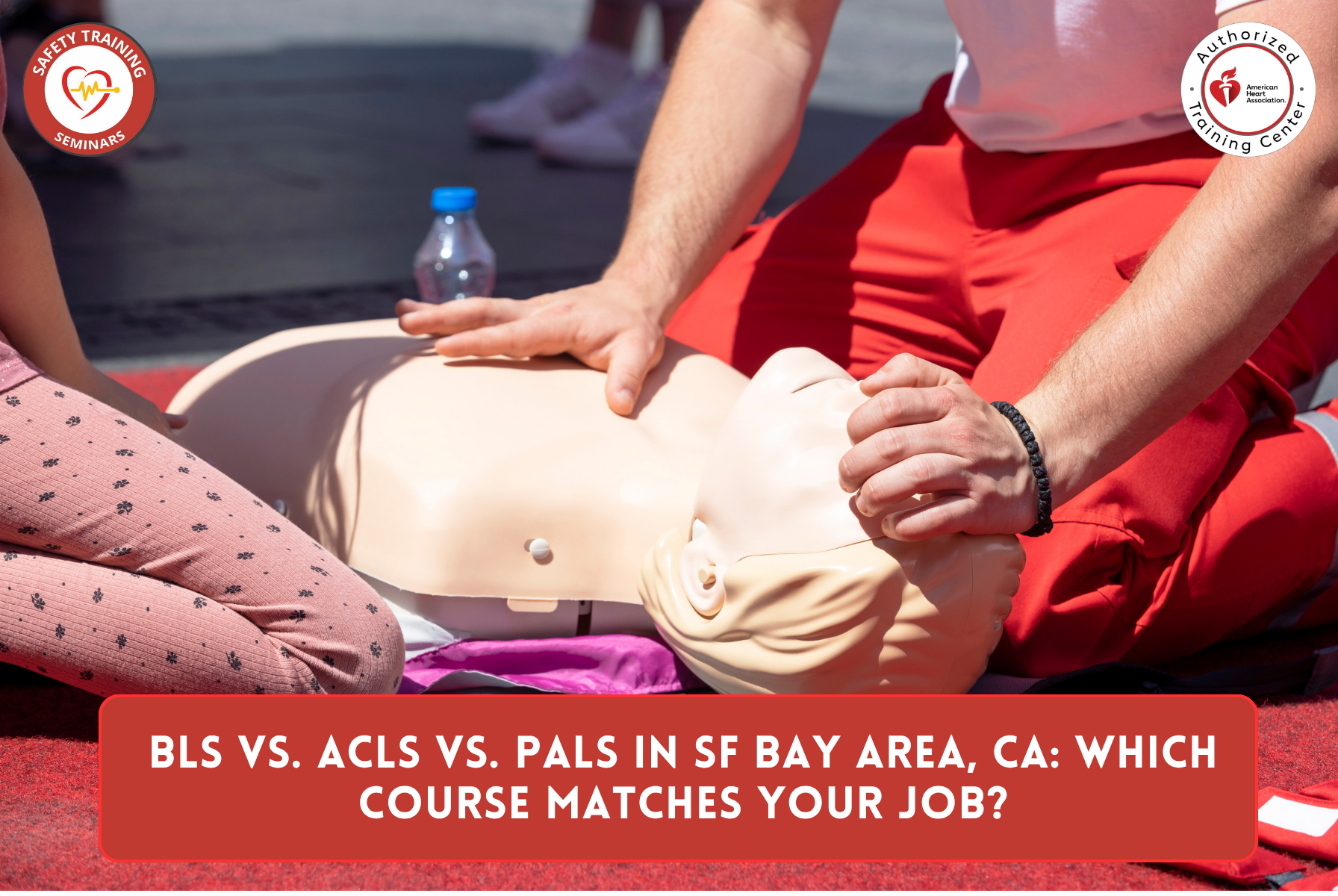
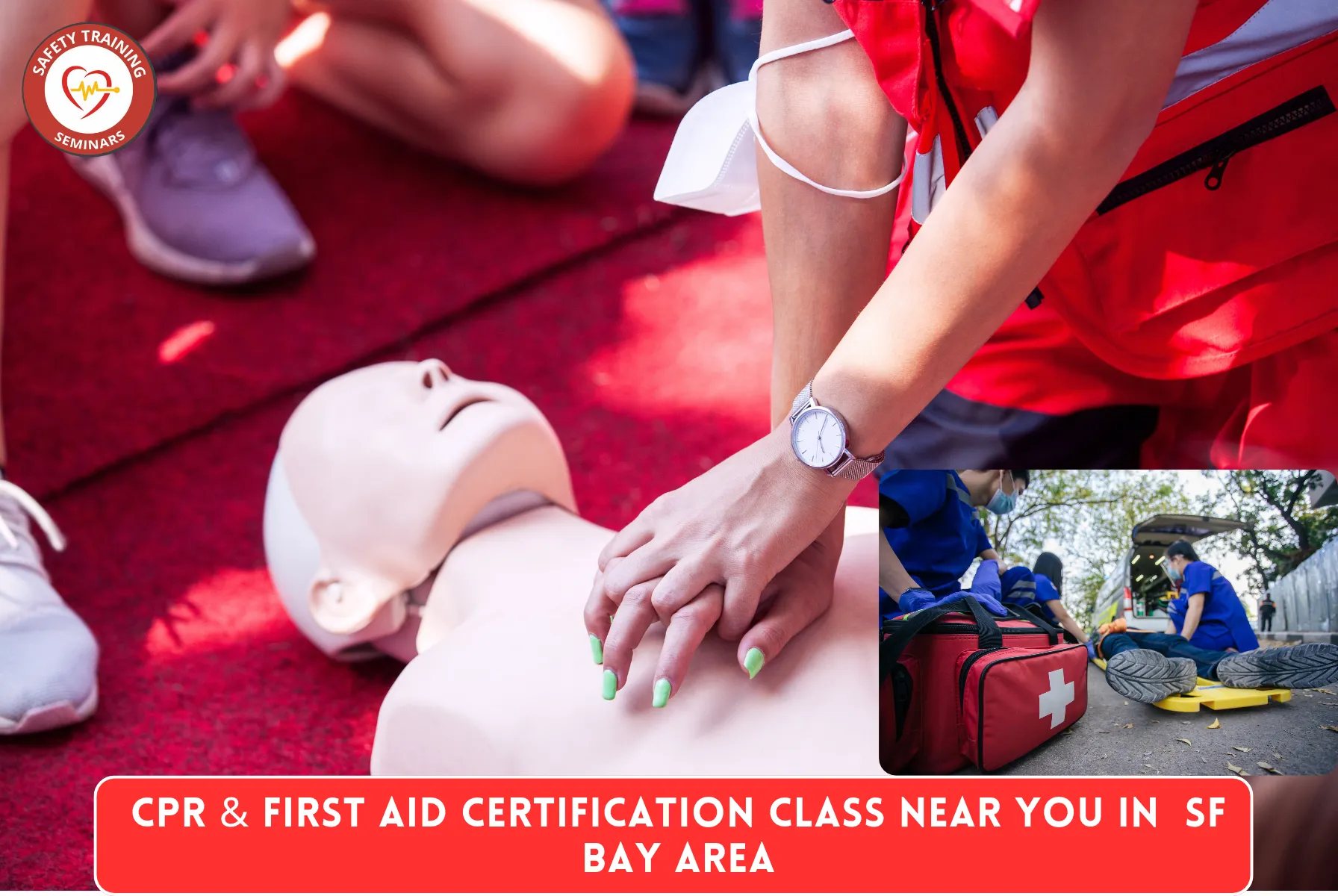
- Chest compressions. You practice compression depth, rate, and hand placement on manikins, with adult CPR as the core skill and child and infant CPR available as optional modules.
- Using an AED. An automated external defibrillator analyzes the heart’s rhythm and gives voice prompts. You practice applying the pads and following the device safely.
- Relieving choking. You learn how to help an adult who is choking.
- First aid for injuries. Topics include controlling bleeding and caring for sprains, broken bones, and shock.
- First aid for sudden illness. You learn to recognize breathing problems, allergic reactions, and the warning signs of heart attack and stroke.
- Environmental emergencies. The course covers heat- and cold-related emergencies and other environmental hazards.
After completing all course requirements, including the skills test, participants receive an AHA Heartsaver First Aid CPR AED course completion card. It is valid for two years and is often issued as an AHA Course Completion eCard. People often call this card a “CPR certification,” but it documents course completion. It is not a professional license, and each employer or organization decides which cards it accepts.
Heading Into Healthcare? Your Program May Ask for a Different Card
There is a sizable healthcare workforce in the Bay Area, and many students are getting ready to work in this field. Nurses, doctors, dentists, and pharmacists are trained at UCSF’s Parnassus Heights and Mission Bay campuses. Zuckerberg San Francisco General Hospital and UCSF have collaborated since 1873. Medical assistants, nursing assistants, technicians, and front-line support personnel are employed by hospitals, clinics, and dental offices around the region.
If you work in or are entering one of these roles, a Heartsaver CPR & First Aid card may not be what your employer or school expects. Healthcare settings typically use a separate set of AHA courses:
- Basic Life Support (BLS) is the AHA’s core course for healthcare providers. It covers high-quality CPR for adults, children, and infants, AED use, team-based resuscitation, and bag-mask ventilation. Nursing students, medical assistants, EMTs, and dental teams are often asked for BLS.
- Advanced Cardiovascular Life Support (ACLS) builds on BLS for clinicians who manage adult cardiac emergencies, such as nurses in emergency, critical care, or telemetry units.
- Pediatric Advanced Life Support (PALS) focuses on assessing and treating seriously ill or injured infants and children.
Some roles need BLS alone. Others combine BLS with ACLS or PALS. Some patient-facing positions that aren’t clinical may accept a Heartsaver card. Requirements vary by employer, school, clinical site, and profession, so before you book a class, ask your program coordinator or hiring manager for the exact course name in writing. That one step can save you from repeating a course before a clinical rotation or start date.
Four Questions That Point You to the Right Course
Most people can identify the right course by answering four questions honestly.
1. Who asked you to train? An office manager, HR team, or youth league usually wants Heartsaver First Aid CPR AED. A hospital, clinic, dental practice, or nursing program usually wants BLS. If you’re training for your own peace of mind, choose the course that matches the people you’re most likely to help.
2. Whom are you most likely to help? Adult CPR is the core of Heartsaver training. Parents, nannies, grandparents, and coaches of young athletes should look for a course that includes the child and infant CPR modules.
3. Do you work in childcare or early education? California applies its own rules here. Childcare providers generally need pediatric First Aid and CPR training approved by the California Emergency Medical Services Authority (EMSA). A general workplace CPR card does not automatically meet that standard, so preschool and daycare staff should confirm EMSA approval before enrolling.
4. How do you want to learn? The AHA offers Heartsaver First Aid CPR AED as a full classroom course or as blended learning, in which you complete an online portion and then attend a hands-on skills session. Either way, an in-person skills check is required to earn the AHA card. Formats differ by course and provider, so confirm what’s available before you register.
Whatever you choose, note your card’s expiration date. AHA Heartsaver cards are valid for two years, and planning your renewal early helps you avoid a lapse right before a job start or audit.
Training With Safety Training Seminars in San Francisco’s Mission Bay
Safety Training Seminars teaches American Heart Association courses, and its Mission Bay training center sits on Townsend Street near Oracle Park and the UCSF Mission Bay campus:
Safety Training Seminars – San Francisco (Mission Bay) 350 Townsend St, Suite 426 (4th floor) San Francisco, CA 94107 (415) 437-1600
The Mission Bay location offers CPR and First Aid courses alongside BLS, ACLS, PALS, and NRP (Neonatal Resuscitation Program). An office worker, a soccer coach, and an ICU nurse can each find the course that fits their role in one place. Safety Training Seminars also operates other San Francisco classrooms, including locations on Van Ness Avenue, Bayshore Boulevard, and Taraval Street, as well as offices in other Bay Area cities.
To see current class dates, available course formats, and pricing, visit the page for CPR & First Aid certification course in SF Bay Area options before you register.
Bay Area Learners Often Ask
What is the difference between CPR & First Aid and BLS?
CPR & First Aid (AHA Heartsaver First Aid CPR AED) is designed for the general public and workplace responders. BLS is designed for healthcare providers and adds team-based resuscitation and bag-mask ventilation. A healthcare employer or clinical program will usually ask for BLS specifically.
Should I take child and infant CPR?
If you care for, teach, or coach children, yes. Technique changes with a person’s age and size, and the Heartsaver course offers child and infant CPR modules alongside adult CPR.
Is there an AED in my office building?
Possibly. California requires AEDs in certain buildings built or renovated since 2017, but not in every building. Ask your building manager or safety coordinator where the nearest AED is kept, before you ever need it.
How long is my CPR & First Aid card valid?
The AHA Heartsaver First Aid CPR AED course completion card is valid for two years. Plan to renew before it expires.
When will I receive my card?
Safety Training Seminars states that it issues AHA cards the same day as your class. Ask how your employer or school wants the card submitted, which is usually as an AHA Course Completion eCard.
Can my company schedule training for a team?
Safety Training Seminars offers onsite CPR and First Aid courses in San Francisco. Contact the training center to discuss group size, course choice, and location.
Be the Person Who Knows What to Do
The right course depends on your role. Heartsaver First Aid CPR AED fits most workplaces, families, and coaches. BLS fits healthcare. EMSA-approved pediatric training fits California childcare. Once you’ve confirmed which one you need, the rest is scheduling. Explore CPR and First Aid certification classes in the SF Bay Area from Safety Training Seminars, and choose a session at the Mission Bay training center that fits your week.